As an Amazon Associate, we earn from qualifying purchases with no additional costs for you.
When heading into the wild, whether it’s a weekend hike, a deep-woods bushcraft mission, or a casual camping trip, your knife isn’t just a tool. Potentially, it’s your lifeline. The right blade can mean the difference between a warm shelter and a cold night, a hot meal or raw frustration, and in some cases, comfort versus chaos. But not all knives are built the same, and not every outdoor task calls for the same edge.
Most knives have features designed for specific tasks, which makes it difficult to find a one-knife-fits-all outdoor knife. Some steel types, blade shapes, grind types, and overall knife weight and length mean that most outdoor adventures will require more than one knife in your gear.
In this guide, we’ll break down the blade types that excel in different wilderness situations. From wood carving and fire prep to food handling and shelter building, we’ll help you match the right tool to the right job. Whether you’re new to the outdoors or leveling up your survival kit, understanding how blade design meets function is the first cut toward confidence out there.
Camping, Hiking, Bushcraft: Know the Difference

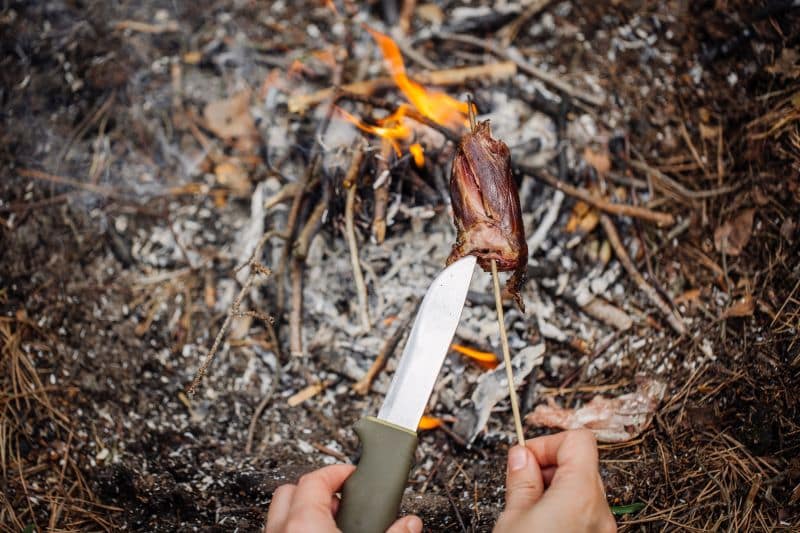
Before exploring knife selections, it’s essential to understand the nature of your outdoor activity. The knife you carry for an overnight hike isn’t the same blade you’d rely on for long-term bushcraft adventure. Each outdoor discipline comes with its own set of demands, and your gear should reflect that.
Hiking: Lightweight and Practical
Hiking is about covering ground. Whether you’re on a day trail or tackling a multi-day trek, every ounce in your pack counts. For hikers, knives are typically used for quick tasks: cutting cordage, slicing food, making minor gear repairs, or emergency use.
What to look for:
- Folding knives or lightweight fixed blades with slim profiles.
- One-handed deployment and pocket clips for fast access.
- Blade shapes like drop point or clip point for general utility.
- Stainless steel over carbon steel to reduce maintenance on the trail.
TIP: Find out my TOP 3 picks of pocket knives if you are interested in buying a pocket knife (Amazon link):
- Victorinox Swiss Army Rangergrip knife: Our favorite feature is the one-hand-opening lock blade, a crucial feature of this tool.
- Opinel No.8 Carbon Pocket Knife: Robust, reliable everyday carry knife, suitable for those who only want a knife blade on their pocket knife.
- Spyderco Para 3 Maxamet Pocket Knife: Lightweight knife featuring a blade made from high-performance Maxamet steel, with a full flat grind for edge durability and easy sharpening.
Camping: Versatile and Comfortable
Camping involves more stationary activities such as cooking, gathering wood, building fires, and maybe a bit of carving or minor bushcraft. Your knife becomes a multi-role tool around the campsite, and comfort in the hand becomes more important for extended use.
What to look for:
- Fixed blades with moderate blade lengths (3.5–5 inches).
- Ergonomic grips for prolonged handling.
- Blade shapes that balance slicing and piercing (e.g., drop point, spear point).
- Sheaths that allow easy access around camp.
Many campers prefer something like the Morakniv Companion (Amazon link), praised for its comfort, affordability, and all-around campsite functionality. (Check out our full review of camping knives for more picks.)
Bushcraft: Precision and Durability
Bushcraft is the art of wilderness living. Think: building shelters, processing firewood, crafting tools, and living off the land. The demands here are heavier, and your knife must be up for the challenge—often doubling as an axe, chisel, or carving tool.
What to look for:
- Full-tang fixed blades with robust construction.
- High carbon steel for edge retention and fire-starting (via ferro rods).
- Blade shapes like Scandi grind or straight-back for carving and control.
- A handle that offers both grip and shock absorption during heavy use.
A popular option in the bushcraft community is the ESEE 4 (Amazon link), known for its strength and reliability under harsh conditions.
TIP: Prefer compact over bulky? Check out our “How to Build a Knife Collection on a Budget” guide—great EDC picks like Kershaw and CIVIVI prove good knives don’t need to be oversized.
Read: How to Build a Knife Collection on a Budget
Fixed vs. Folding: What Works Where

One of the biggest decisions outdoor enthusiasts face is whether to carry a fixed blade or a folding knife. Both have their place in the wild, but the right choice depends on your activity, priorities, and personal comfort level.
Fixed Blades: Strength and Reliability
Fixed blades are the go-to choice for high-impact outdoor tasks. With no moving parts, they’re stronger, easier to clean, and more reliable under stress. If you’re batonning wood, skinning game, or building shelter, a fixed blade won’t let you down.
Advantages of fixed blades:
- Full-tang designs offer unbeatable strength.
- Better suited for heavy-duty tasks like chopping or prying.
- Easier to clean and maintain, especially in muddy or wet conditions.
- Compatible with fire-starting techniques like striking a ferro rod on the spine.
Drawbacks:
- Bulkier to carry.
- Requires a sheath or belt carry system.
If you’re headed into remote terrain where your knife might be your most-used tool, a fixed blade is the smarter choice. The Becker BK2 (Amazon link), for example, is a tank of a knife that bushcrafters and survivalists trust when things get real.
Folding Knives: Compact and Convenient
Folding knives are ideal for lighter outdoor activities—especially when portability matters. If you’re hiking, backpacking, or just want a backup blade in your pocket, folders deliver quick access in a compact package.
Advantages of folding knives:
- Easy to carry in pockets or clipped to gear.
- Discreet and legal in more urban or mixed-use areas.
- Great for everyday carry (EDC) and backup use.
Drawbacks:
- Moving parts can fail or get gummed up.
- Not suited for high-impact tasks like splitting wood.
- Less durable over the long term than fixed blades.
Folding knives like the Benchmade Bugout (Amazon link) strike a great balance between weight, utility, and durability—making them a favorite among ultralight hikers and EDC enthusiasts alike.
Pro Tip: Many seasoned outdoorsmen carry both—a rugged fixed blade for core tasks, and a lightweight folder for fine detail or quick jobs. We’ll cover more on that combo approach later.
Blade Shapes for Wood, Fire, Shelter, and Food
The shape of your knife blade is about performance rather than just about looks. Each design has unique strengths (and a few weaknesses) depending on what you’re doing outdoors. Here’s how to choose the best blade shape for essential wilderness tasks like processing wood, starting fire, building shelter, and preparing food.
1. Drop Point: The Do-It-All Workhorse
The drop point is arguably the most versatile blade shape. With a convex spine that “drops” toward the point, it offers a strong tip without sacrificing slicing ability.
Best for:
- General wood processing
- Feathersticking for fire prep
- Food prep
- Carving tent stakes and tools
Why it works: The curved belly is ideal for slicing, while the thick spine can handle light baton work. If you’re packing just one knife, a drop point is a safe bet.
Try this one: The Fallkniven F1 (Amazon link) is a premium survival knife with a classic drop point, used by military pilots for a reason.
2. Scandi Grind (Typically Straight-Back or Drop Point): The Bushcrafter‘s Blade
This isn’t a shape, but rather a grind—a style of sharpening that leaves a single, wide bevel. Scandi grinds are incredibly popular in bushcraft circles for their carving precision and ease of sharpening.
Best for:
- Carving and whittling
- Making feathersticks
- Crafting traps, tools, and notches
Why it works: The wide bevel bites into wood without slipping, making it ideal for controlled cuts and precision work. Plus, it’s easy to sharpen in the field, no fancy tools needed.
3. Clip Point: Piercing and Precision
With a spine that dips into a fine point, the clip point excels at piercing tasks. It’s also great for detailed slicing and precision cuts.
Best for:
- Cleaning fish or small game
- Food prep (especially slicing meats)
- Carving and fine bushcraft work
Why it works: That narrow tip gives you scalpel-like control, but it’s also more fragile. Skip the baton work, clip points aren’t built for abuse.
Popular in classic survival knives (think: Bowie knife), the clip point balances elegance with utility.
4. Tanto: Tough but Task-Specific
Originally a Japanese design, the tanto blade features a strong angular tip that’s excellent for piercing tough materials. It’s more common in tactical knives than outdoor ones, but it has its place.
Best for:
- Puncturing tarps or hides
- Emergency use (glass breaking, digging)
- Urban survival or bug-out bags
Why it works: The reinforced tip is insanely strong, but the lack of belly makes it a poor slicer. It’s a tactical specialist, not a camp kitchen tool.
For field use, the tanto shape is overkill unless you’re preparing for extreme scenarios. That said, some folks like it for its rugged aesthetic and no-nonsense attitude.
5. Sheepsfoot & Wharncliffe: Control and Safety
These flat-edge blade shapes have a spine that drops down to meet a straight cutting edge. They’re not meant for stabbing, which makes them safer and ideal for precision slicing.
Best for:
- Food prep (especially vegetables and slicing meats)
- Controlled carving tasks
- Whittling and rope work
Why it works: The flat edge gives you maximum control and cuts cleanly through material. These blades shine in the campsite kitchen or while carving clean lines into soft wood.
Looking for one? The Spyderco Atlantic Salt (Amazon link) is a folding sheepsfoot blade made from rust-proof H1 steel, which is great around water.
Choosing the right blade shape is like picking the right tool from a toolbox. One might handle fire prep like a champ, while another makes food prep a dream. If you’re into multi-use gear, a drop point or Scandi grind is your best bet. If you’re looking to specialize, it pays to know what blade does what.
Case Study: Knife Loadouts from Survival Experts

Want to know how real survivalists and outdoor professionals choose their blades? Let’s take a look at what the experts actually carry when they head off-grid. These “knife loadouts” reflect practical wisdom, not marketing hype. Each tool has a purpose.
1. Dave Canterbury‘s 5 Cs of Survivability
Dave Canterbury, co‑founder of Pathfinder School and author of Bushcraft 101, continues to prioritize a sturdy full-tang fixed blade as his primary cutting tool. His signature kit still embraces the “Five Cs”—Cutting, Combustion, Cover, Container, Cordage, emphasizing gear that supports every survival need.
Typical choice:
- Full-tang fixed blade (~4–6″), often with Scandi or saber grind
- Folding saw (e.g. Silky Gomboy) to complement the knife
- Secondary small fixed or folder for detail work
2. Joe Robinet‘s Bushcraft Adventure Kit
Joe Robinet, a popular bushcraft YouTuber, often highlights the importance of having multiple blades. His go-to setup includes a beefy camp knife, a carving blade, and sometimes even a folding saw.
Typical loadout:
- Adventure Sworn bushcraft knife (custom)
- Small companion knife (Mora or similar)
- Folding saw (Silky Gomboy)
Why: Joe’s kit reflects a layered approach—heavy tasks handled by a durable fixed blade, fine detail by a smaller knife, and wood processing by a saw. He tailors his kit to the trip.
Combine Blade + Saw + Multi‑tool (Modern Kit)
Today’s top instructors and content creators, such as Dave Canterbury and Joe Robinet, almost universally recommend:
- A robust fixed blade for splitting, carving, fire prep.
- A folding saw (e.g. Silky Gomboy – Amazon link) for wood processing, reducing strain on the main blade.
- A multitool for hardware adjustment and camp tasks.
Functionality and Redundancy
Across the board, experienced outdoorsmen tend to follow a common principle: have at least two cutting tools; a primary fixed blade and a backup or specialty blade. Some even go a step further and include a multitool (more on that in the next section).
From bushcraft schools to YouTube trail logs, these experts agree: one knife rarely does it all. Smart selections combine durability, control, and efficiency. And if one tool fails? You’ve got a backup.
Combining Knives and Multitools Effectively

One of the smartest moves any outdoorsman can make is pairing a solid knife with a well-chosen multitool. This pairing is less about redundancy and more about covering gaps. Where your knife cuts, your multitool tweaks, tightens, opens, saws, and fixes.
Why Two Tools Are Better Than One
No matter how tough your knife is, there are things it just shouldn’t do with your knife, like turn screws, snip wire, or file down gear. That’s where a multitool fits right in.
A multitool adds:
- Pliers for gear repair or pulling hot pots from the fire
- Mini saw for notching and small-wood work
- Screwdrivers for adjusting camp stoves, gear, or trekking poles
- Scissors and can openers—lifesavers when you least expect it
- Bit drivers, wire cutters, and even ferro rod scrapers in advanced models
Fixed Blade + Multitool = Survival Sweet Spot
This combo gives you the brute force of a fixed blade and the finesse of micro tools. Many survival instructors recommend this exact loadout for extended wilderness trips.
Example Loadout:
- Primary: ESEE 4 (fixed blade)
- Secondary: Leatherman Signal or Victorinox Swisstool Spirit (Amazon link)
Why it works: Your fixed blade handles all cutting, carving, and fire prep. The multitool picks up the slack on camp chores, minor repairs, and emergencies.
Looking for the right multitool? Our guide on the 5 Best Multitools for Camping & Survival breaks down top picks based on real field performance.
Folding Knife + Multitool: Lightweight, Urban-Friendly Option
For hikers or weekend campers, a folding knife + multitool combo keeps things light but versatile. While it won’t match a fixed blade in toughness, it’s perfect for low-risk environments.
Great for:
- Day hikes
- Urban survival kits
- Casual camping trips
Pro tip: Pick a multitool with a locking knife blade. That way, you’ve got a backup blade that can handle basic cutting tasks if your primary blade goes missing or dull.
Legal Considerations in Wilderness Areas
Before you pack that oversized survival blade or slick new folder, it’s worth asking: Is it legal where you’re going? Knife laws vary wildly by country, state, province, and sometimes even by specific parks or wilderness zones.
Know the Rules Before You Go
You might assume that heading into the woods means fewer restrictions, but that’s not always the case. Many protected areas and national parks have specific rules around what types of knives you can carry—especially if you’re crossing borders or moving between public and private land.
Key things to check:
- Blade length restrictions (commonly capped at 3–4 inches in some areas)
- Folding vs. fixed blade legality
- Prohibited features like assisted opening, double-edged blades, or concealed carry
- Local park or forest policies, which sometimes have unique gear rules
For example, in the U.S., national parks often follow federal guidelines, but individual state laws still apply, which means you might be legal in one zone and in violation just a few miles later.
International Travel – Read the Fine Print
If you’re traveling abroad for a bushcraft course, backpacking trip, or expedition, your trusted blade could get you stopped at customs, or worse. In the UK, for instance, fixed blades and locking folders are generally restricted in public unless you have a “good reason.”
TIP: Flying with a knife can be a complicated affair, especially when crossing state or international borders. Take a look at our article dedicated to the topic here:
Taking A Knife On A Plane?
Backcountry vs. Campsite
Interestingly, backcountry areas often have more relaxed enforcement, but that doesn’t mean you’re off the hook. If you’re passing through ranger checkpoints or visiting high-traffic campgrounds, you might still be subject to a gear inspection.
And even if a knife is legal, how you carry it matters too. Open carry is usually safer legally than concealed carry, especially with fixed blades.
Final Word: Responsible Carry
Knife laws exist to balance public safety with personal freedom. As someone who respects the outdoors, and the tools that come with it, it’s up to you to carry responsibly. Know the laws. Respect local policies. And always keep your blade sheathed when not in use.
Conclusion
Choosing the right knife for outdoor adventures isn’t about brand names or cool factor. It’s about function, fit, and knowing exactly what your blade needs to do when you’re miles from help. Whether you’re carving tent stakes at a cozy campsite, starting a fire in the rain, or carving spoons on a week-long bushcraft trek, the blade you carry should match your mission.
Think about where you’re going, what you’ll be doing, and how much you’re willing to carry. Start with one solid knife that fits your style, and build from there. Choose your knives carefully before your outdoor adventure, it might just save your life out there.