As an Amazon Associate, we earn from qualifying purchases with no additional costs for you.
In the modern digital marketplace, the attraction of high-end knives comes with an unfortunate side effect: a booming counterfeit industry. As popular designs fly off the shelves, unscrupulous sellers often capitalize on demand by offering fake or clone versions that mimic reputable brands.
These look-alikes can seriously disappoint, or worse, pose safety risks due to subpar materials, construction flaws, or deceptive branding. Look for telltale signs to spot counterfeit knife brands and clones, such as inconsistencies in logos, markings, marketing, pricing, and packaging, among others.
Our goal is to help enthusiasts and professionals alike separate genuine artisan craftsmanship from mass-produced imitations. Whether you’re adding to your collection or hunting for your next workhorse blade, this guide will give you the keys to identify fakes, weigh the ethics of clones, and steer clear of shady sellers.
The Rise of Knife Counterfeits Online

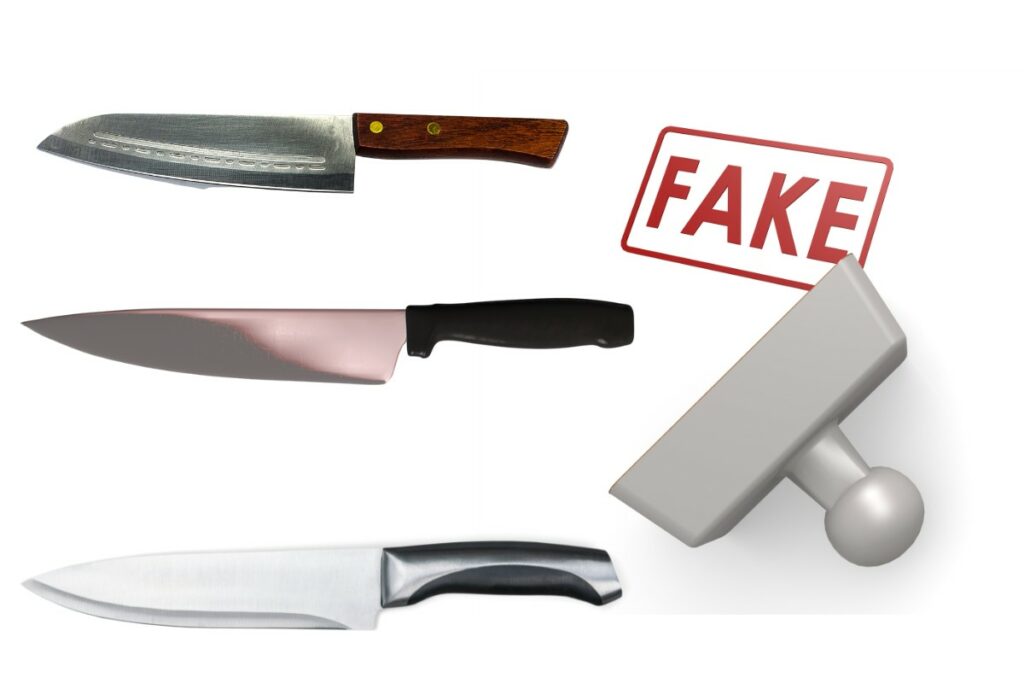
With the surge in online shopping, particularly on large marketplaces like eBay, AliExpress, and even Amazon, knife counterfeiters have found the perfect platform to reach unsuspecting buyers. Many fake listings employ high-quality photos, rating systems, and marketing tactics that mimic legitimate sellers. Some even go as far as using stolen branding or forging serial numbers.
Key trends fueling the counterfeit market include:
- Globalized manufacturing that offers low-cost mass production.
- Resale platforms that allow for anonymous seller accounts and minimal oversight.
- Limited-edition drops create hype, then saturation via knockoffs.
The end result is that buyers end up paying top dollar for blades that fail to deliver in terms of steel quality, fit and finish, or performance.
Recognizing these fakes isn’t always straightforward, but many carry telltale signs. In the next section, we’ll walk through practical red flags in packaging, branding, and craftsmanship.
Tip: Japanese knives can also be faked. Learning how to tell the difference between the real deal and a fake Japanese knife is the topic of this article.
Spotting FAKE Japanese Knives: 8 Features To Watch Out For
Signs of a Fake: Packaging, Branding, Construction
Spotting a counterfeit knife often starts before you even touch the blade. Counterfeiters cut corners at every stage, from flashy packaging to shoddy craftsmanship. Here are examples of what to look for:
1. Packaging Issues
- Cheap or incorrect boxes: Genuine knives typically come in sturdy, well-branded packaging, whether it’s a wooden box, printed cardboard, or clamshell. If the box feels flimsy or the printing appears low-quality, that’s a red flag.
- Missing documentation: Trusted brands usually include a warranty card, serial number, or care instructions. Fakes often skip these entirely or provide poorly printed versions.
- Spelling mistakes & logos off-centered: Watch for misaligned branding or misspelled product names. These are common errors that are easy to spot once you know what to expect.
2. Branding & Markings
- Blade etch quality: Genuine makers use etching or laser engraving that’s crisp and uniform. Look out for blurry, shallow, or uneven logo marks.
- Serial number discrepancies: Many premium knife makers stamp a serial number near the pivot or tang. If the font looks wrong or the number is absent when advertised, suspect foul play.
- Logo placement & scale: Even small deviations like a logo positioned too close to the blade edge or at the wrong scale, can indicate a fake. Compare with official photos for exact positioning.
3. Construction & Fit‑and‑Finish
- Blade centering & action: When opened, the blade should sit perfectly centered. If it rubs or drifts to one side, it’s likely not from the genuine manufacturer.
- Filing marks & rough edges: Inspect cut-outs, spines, and blade flats. A polished, factory-finish edge is sharp and clean. Rough grinding or hand-tool marks can be signs of shortcuts.
- Hardware inconsistencies: Screws, liners, and washers should match official specs. Counterfeits often substitute cheap steel screws or mismatched washers and make pivot screws feel gritty or loose.
- Material substitutions: A clone might use stamped liners instead of milled stainless or omit premium inserts (like titanium or carbon fiber) present in the real model.
Why These Details Matter
Counterfeits don’t just look bad, they can perform poorly or even pose safety risks. A misaligned or unstable blade can twist mid-cut, while low-grade steel may chip or fail under normal use. That’s why we recommend inspecting every detail of packaging, branding, and construction before you buy.
Tip: Choosing the right knife steel is as important as selecting the right knife. Take a look at our detailed breakdown of how to choose the right steel in your knife here:
Full List: Best Knife Steels For Different Knives (+ Why)
Differences in Steel and Heat Treatment

Even when a counterfeit knife looks convincing on the outside, what’s inside—specifically the steel and how it’s heat-treated—tells the real story. Genuine knives are crafted using premium steel alloys that are engineered for edge retention, toughness, and corrosion resistance. Fakes? Not so much.
Why Steel Choice Matters
Top-tier knife brands proudly advertise their steel—CPM-S35VN, M390, VG-10, or Elmax, to name a few—because these alloys are designed to take and hold a fine edge under serious use. Counterfeits usually skip this step, opting for low-end or unmarked steels that dull quickly, chip, or rust.
Heat Treatment: The Invisible Performance Factor
Even if the steel name is correct, poor heat treatment will sabotage its performance. A quality blade is carefully heat-treated to ensure a precise hardness level (usually between 58–62 HRC), giving it a balance of toughness and edge retention. Most fakes skip this entirely—or worse, fake the Rockwell stamp without backing it up.
Here’s a side-by-side comparison to help spot the differences:
Steel and Heat Treatment Comparison
Here’s a side-by-side comparison to help spot the differences:
| Feature | Genuine Knives | Counterfeit Knives |
| Steel Grade | CPM-S35VN, M390, VG-10, Elmax, 154CM | Unmarked steel or low-end 3Cr13, 440A |
| Edge Retention | Excellent – holds edge under extended use | Poor – dulls quickly with regular use |
| Corrosion Resistance | High – often enhanced with coatings | Low – prone to rust spots and staining |
| Hardness (HRC) | 58–62 HRC (consistent) | 52–56 HRC (inconsistent) |
| Heat Treatment Quality | Precision heat-treated, optimized grain structure | Improper or skipped heat treatment |
| Sharpening Response | Sharpens evenly, maintains bevel angle | Uneven, burr-prone edges |
| Common Alloy Substitutions | None – matches advertised steel exactly | Often substitutes unknown Chinese steels |
If your new blade dulls quickly, feels too soft when sharpening, or develops corrosion unusually fast—it might be counterfeit or at least poorly heat-treated.
Trusted Retailers vs. Risky Marketplaces
When buying knives, especially premium or collectible ones, where you shop is just as important as what you buy. While legitimate sellers offer quality assurance and manufacturer warranties, shady marketplaces are a breeding ground for clones, counterfeits, and straight-up scams.
Trusted Retailers: What to Look For
Reputable knife retailers, whether online or brick-and-mortar, offer peace of mind through:
- Authorized dealer status: Brands like Benchmade, Spyderco, and Zero Tolerance list official dealers on their websites. Stick to these lists.
- Clear return policies: If a seller makes returns easy and transparent, it’s a good sign they stand behind what they sell.
- Detailed specs & real photos: Trusted sites show close-ups, disclose steel type, country of origin, and often have customer reviews that match the product.
Popular, verified online retailers include:
These sellers work directly with manufacturers and have reputations built on transparency and service, not shortcuts.
TIP: The popularity of Swiss Army pocket knives have seen a plethora of fake products being sold as genuine articles. Check out how to spot fake ones in the article below:
Real Or Fake Swiss Army Knife: Focus On These 4 Differences
Risky Marketplaces: Proceed With Caution

Marketplaces like eBay, AliExpress, and Amazon aren’t inherently evil, but they host third-party sellers, and that’s where things get sketchy. Many listings feature real product images, glowing (and fake) reviews, and rock-bottom prices that are too good to be true.
Red flags to watch for:
- Suspiciously low prices: If a $200 folder is selling for $49.99, it’s not a deal, it’s a trap.
- Stock images only: No in-hand or close-up shots? They might not even have the knife.
- Seller reviews that don’t match the product: Reviews about socks or toys on a knife listing? That’s a classic clone seller tactic.
A good rule of thumb is to research the seller just as thoroughly as the product when shopping on a marketplace.
TIP: Find out my TOP 3 picks of pocket knives if you are interested in buying a pocket knife (Amazon link):
- Victorinox Swiss Army Rangergrip knife: Our favorite feature is the one-hand-opening lock blade, a crucial feature of this tool.
- Opinel No.8 Carbon Pocket Knife: Robust, reliable everyday carry knife, suitable for those who only want a knife blade on their pocket knife.
- Spyderco Para 3 Maxamet Pocket Knife: Lightweight knife featuring a blade made from high-performance Maxamet steel, with a full flat grind for edge durability and easy sharpening.
Pro Tip: Know What a Real Knife Costs
Before buying, check the official MSRP on the maker’s site. That alone can help you weed out 90% of counterfeit listings. And if you’re hunting for secondhand blades, we recommend using platforms like BladeForums or r/Knife_Swap on Reddit, where community reputation matters and fraud gets called out fast.
Are Some Clones Actually Worth It? (The Ethical Debate)
Some buyers swear by certain clones as “budget-friendly alternatives,” while others won’t touch them out of principle. So… are any of them worth it?
Short answer? It depends who you ask.
What Is a Clone, Anyway?
There’s a difference between a counterfeit and a clone:
- Counterfeits pretend to be the real deal, down to the logo and serial number. They’re designed to deceive.
- Clones, on the other hand, often copy the design but remove the branding. Think of them as “inspired-by” knockoffs—like a $30 ‘Sebenza-style’ flipper that just says “D2” on the blade.
Clones don’t always lie about what they are. In fact, some come from manufacturers who are very open about what they’re doing—they just avoid copyright issues by omitting logos or using different names.
The Pros (If You’re Playing Devil’s Advocate)
- Affordability: Not everyone has $300+ to drop on a premium folder. Clones give people access to the design experience at a fraction of the cost.
- Low-stakes testing: Some folks buy clones to test ergonomics before committing to the real deal.
- No branding, no fraud: When clearly labeled, some clones operate in a legal and ethical gray area—they’re not pretending to be something they’re not.
The Cons (That Are Hard to Ignore)
- Stealing intellectual property: Many clones replicate patented mechanisms or designer shapes without permission. That’s theft, plain and simple.
- Inconsistent quality: Even “good” clones are hit-or-miss. One batch might be fine, and the next might be garbage.
- Undermining the craft: When clones flood the market, they hurt the makers, especially small, independent designers, who put in the real work.
It’s worth noting that several makers have publicly addressed this issue. Chris Reeve Knives, for example, has taken a strong stand against clones for devaluing the care that goes into their build process.
The Bottom Line
If you’re buying a clone knowingly and it doesn’t carry a fake logo, cool. That’s a personal call. But if you’re flipping fakes as “the real deal” or supporting factories that profit from deception, that’s crossing a line.
How to Report or Avoid Scam Sellers

Avoiding scam sellers is the first line of defense, but knowing how to report them helps protect the entire knife community. Whether you’re shopping on a mega marketplace or browsing an obscure knife site, here’s how to spot, dodge, and report the fakes.
How to Avoid Scam Sellers
1. Stick with verified dealers.
We said it before, but it’s worth repeating: authorized retailers are your safest bet. If you’re unsure, cross-reference the seller with the brand’s official dealer list.
2. Check the details.
Look for spelling mistakes, vague specs, or listings that use terms like “style,” “type,” or “OEM” without proper branding—these are red flags.
3. Do a reverse image search.
If a listing uses generic or stolen stock images, run them through Google’s reverse image tool. If they show up on multiple unrelated sites, be skeptical.
4. Research the seller profile.
Check how long the seller’s account has been active, what other items they sell, and whether reviews seem generic or copy-pasted.
How to Report Them
If you do encounter a scam seller or counterfeit listing, take a minute to report it. It might help someone else avoid a costly mistake.
- Amazon: Scroll to the product details and click “Report incorrect product information” or contact Amazon customer service directly.
- eBay: Use the “Report Item” link on the listing. eBay has specific options for counterfeit or trademark-infringing items.
- AliExpress: Click “Report Item” or open a dispute if you already purchased.
Also, consider submitting a complaint to the brand’s official website. Most have fraud or support teams that track counterfeits and may even pursue legal action against repeat offenders.
Conclusion
In a market flooded with flashy photos and too-good-to-be-true prices, staying sharp is more important than ever. Knowing how to spot a fake, by examining the packaging, branding, steel, and heat treatment, can save you serious money and disappointment. And while the clone debate will continue, one thing is clear: authenticity isn’t just about a logo. It’s about performance, trust, and respect for the craft.
When in doubt, buy from trusted sources, do your research, and never hesitate to ask the community for help. Whether you’re a seasoned collector or a first-time buyer, being informed is your best defense.
TIP: True Damascus steel has advantages for knives, but many suppliers fake a Damascus look on knives to drive up the price. Find out how to spot fakes ones in the article below:
6 Main Differences: Real Vs. Fake Damascus Steel On A Knife